

When Dolly Parton was born in 1946, average U.S. life expectancy was 77.64 years for women and 71.65 years for men. As with much of her life, she exceeded expectations, living to be 80.60 years old. Women’s labor force participation was roughly 28% that decade, climbing to about 31% by 1950 as the postwar economy reshaped who worked and why.
Table 1: Women’s labor force participation rate, 1940 vs. 1950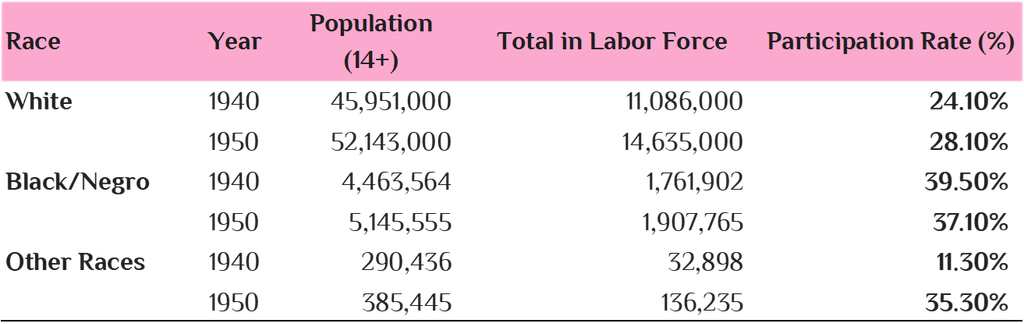
This week and the weeks ahead, tributes to her legacy will play Dolly songs: “Jolene,” “I Will Always Love You,” and “9 to 5,” among them. Each of her songs will resonate differently with fans and people who didn’t know they were fans (me). But on this 106th anniversary of Women’s Equality Day, the song that I keep singing in my head is “9 to 5.” During the pandemic, I learned that the movie “9 to 5” was based on the nonprofit 9to5.org, which was created to demand better working conditions for clerical workers.
Today, 9to5 is “fighting for economic justice for those most harmed by centuries of racism and sexism: women and nonbinary people of color.”
Barely getting by, it’s all taking and no giving.
Dolly wrote “9 to 5” in 1980, but her lyrics can serve as a policy brief for 2026.
“They just use your mind, and they never give you credit”
That’s called “hepeating,” when colleagues ignore her ideas but acknowledge the same comment from a male. Institutions invite (few) women to have a seat at the decision table. Although the number of women Fortune 500 CEOs is at a record high (11%), their representation remains precarious. Since 2000, only three Black women and two Latinas have led a Fortune 500 company. Priscilla Almodovar’s departure from Fannie Mae reduced Hispanic women’s representation to zero late last year. Asian women represent the largest subgroup of female Fortune 500 CEOs (less than 2% of all Fortune 500 CEOs), including Dr. Lisa Su at AMD, Reshma Kewalramani at Vertex Pharmaceuticals, and Gunjan Kedia at U.S. Bancorp. To date, no Indigenous woman has ever led a Fortune 500 company.
“It’s enough to drive you crazy if you let it.”
That line could be the subtitle for this week’s Supreme Court news. On Monday, the Court cleared the way for President Trump’s executive order restricting mail-in voting to proceed, ruling on standing (States didn’t have it) rather than on the merits, but this is not a final judgment on the order’s legality. For the women who fought to secure the right to vote, this week’s decision is a reminder of how fragile a “won” right can be when enforcement depends on the composition of the courts. We may let this challenge to our rights make us weary. But never crazy.
It’s a rich man’s game no matter what they call it. And you spend your life putting money in his wallet.
As if inflation wasn’t enough, new tariffs! The Yale Tax Lab estimates the new tariffs on Canada, added to the old tariffs, will now cost American families about $1,100. For octogenarian women, already near or below 200% of the poverty line (see Table 2), these tariffs will force life-sustaining tradeoffs for women already experiencing fiscal fragility.
Table 2: Poverty among octogenarian women, by marital status and threshold
And the tide’s gonna turn, and it’s all gonna roll your way (I just know it).
Here’s what made Dolly beloved. She didn’t just write “9 to 5” for the frustrated. She understood that when the tide turns and rolls your way, there is a responsibility to help others. She was charitable with the money she made from her songs. Since 1995, she has donated her wealth to increase literacy through the Imagination Library, which has mailed free books to millions of kids. No eligibility test required — just a mailbox and a kid who needs a story to fuel their imagination.
WISER wants to do our small version of that. Over the past two years, we’ve purchased copies of “My First Game” by Willie Woods (my Highland Springs High School classmate) for local schools and libraries. This year, we’re buying copies of I Am the Dream Come True by Marley Dias, Dr. Janice Johnson Dias, and Scott Dias to donate to the GrassROOTS Community Foundation and schools in Virginia and North Carolina. I encourage you to donate a book to a local library or school in the upcoming weeks. Doing so puts a story in a kid’s hands and stimulates their imagination to dream about possibilities not yet seen.
This is also the last week to give to our WISER Women campaign, which closes on August 31, 2026. All month, I have asked that you give $60 to WISER in honor of a woman who influenced your life. Today I ask that you give in honor of a woman who worked 9 to 5 to make a living. Your gift funds the data disaggregation, policy analysis, and advocacy that keeps women’s political and economic power from getting quietly legislated away.
You can find the lyrics to “9 to 5” here. My condolences to Dolly Parton’s family.
Stay sharp, buy a book, and don’t let ’em take your dreams away.
Rhonda V. Sharpe is the president and founder of the Women’s Institute for Science, Equity and Race. Her research focuses on gender and racial inequality, STEM diversity, and the demographics of higher education.