

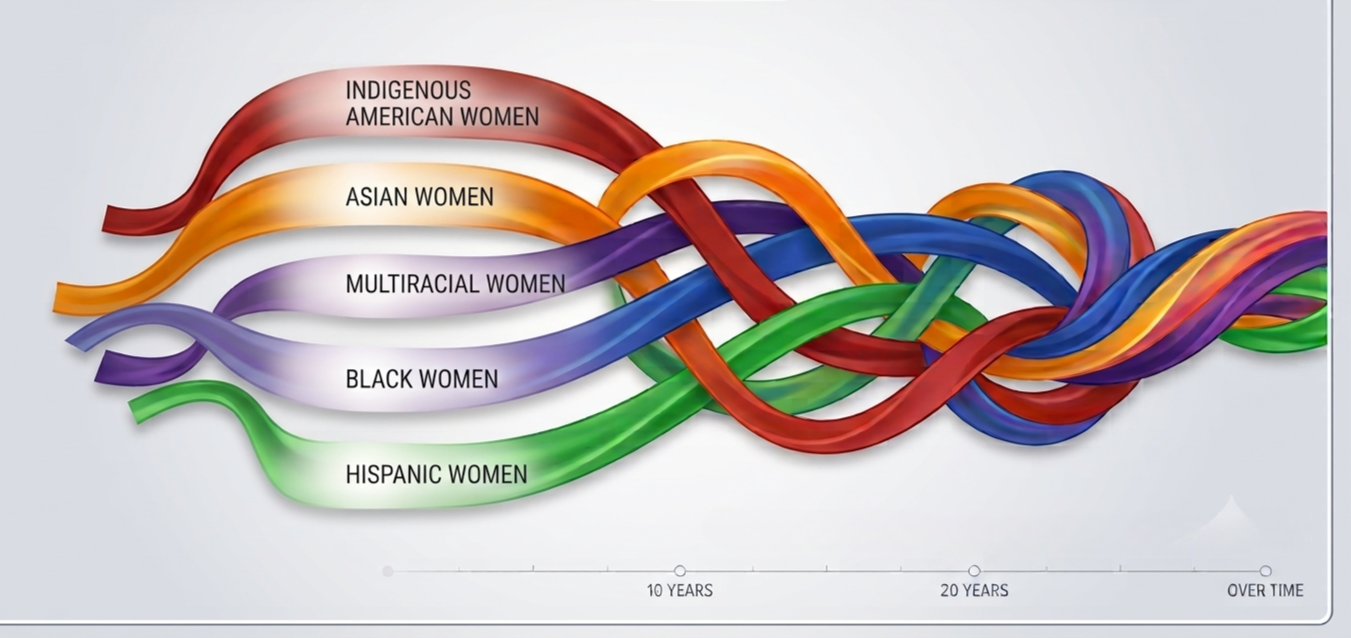
I’ve been exploring my research interests and was reminded of a time when I was sitting at the dinner table as a young girl. One evening, I brought a new question: ‘What are we?’ We went around the table: My sister? African American. My dad? African American. Me? African American. My mom? African American? Nope. It never occurred to me that my mom would be different. That’s when I first learned something that shaped my research: although race is tangible in its consequences, it is also a learned, performed social construct. Integrating cultural norms into our understanding of racial identity reveals how identity can be fluid rather than reduced to a single descriptor. Beyond a box you check, race is also what you eat at the Thanksgiving table. This memory piqued an interest that this project finally allowed me to investigate. That question-‘Who am I, how am I counted?’-sits at the heart of debates about how agencies should measure racial equity over time.
Bringing Summer Studies to Your Table
At the American Economic Association’s Summer Program at Howard University, I returned to my curiosities about racial identity. I wanted to know how frequently people self-select into different racial groups. Most people describe their racial identity consistently across survey waves, but not everyone does.
Table 1 shows the stability rates, the percentage of each group that remains in the same racial group, by race, ethnicity, and sex. Disaggregating multiracial identities allows us to see that people coming from combinations of Black, Hispanic, Asian, and Indigenous backgrounds identify differently from those with White racial backgrounds. Roughly one in ten adults, or 15%, changed their racial identity at least once across a six-year period, using data from GSS panel surveys conducted between 2006 and 2014. This relatively small number still suggests that for some groups, racial identity is an evolving category rather than a fixed trait.

At the aggregate, Asian, Black, and White groups have high stability. The Hispanic, Indigenous, and multiracial groups showed high levels of fluidity (see Table 1). Asian, Hispanic, Indigenous, and White women have slightly lower stability, which highlights the need to disaggregate data by gender, underscoring how gendered patterns of identity shift can be obscured in aggregate statistics.
Table 2 maps women’s racial group identity at the start and end of the study. I found 52% of Hispanic women later identified as White, and 70% of women who identified as a Major Black Combo dropped Black as a race they identified with. For Major White Combo women, 54% moved to identify as Hispanic. For women who were Other multiracial, 45% moved to identify as White. A small share of respondents who initially identified as multiracial later reported having a singular White identity. As Figure 1 illustrates, more than half of the women who initially identified as Hispanic later identified as White, and nearly half of the women who identified as Other multiracial moved to a singular White identity.
Table 2. Percentage of Women by Racial and Ethnic Identity

Fixed Menu, Fluid Identities
\Although Hispanic is not a racial identity, many respondents racially identify this way, which provides detail on how racial identity doesn’t always match with prescribed categorization. Hispanic identity is the least stable among single-race groups, where only 43% remain Hispanic in the next wave, a reminder that ethnicity and race interact in ways traditional categories miss.
People who change their racial identity also share some characteristics. They tend to be younger, less likely to be married, and less educated than those who remain in the same category. Women make up slightly more of the people who change their racial category, at 55%, highlighting the importance of looking at race and gender together. These patterns suggest that racial identity changes may be more common during transitional life stages.
Black and White women in the single-race categories have very similar stability rates, at 94% and 97%, respectively (See Table 1). Shared experiences of gendered discrimination may help explain similar stability across race for Black and White women, as some research finds that racialized discrimination can strengthen group identity for Black women.
Counting the Uncounted
Prior research suggests fluidity can be explained by resistance to prescribed racial categories or a response to discrimination, where people then identify more strongly with their racial group. Fluidity can offer one way people navigate social systems, especially when they perceive that affiliating with one group or another may shape access to resources or social treatment. Robert Reece has shown that multiracial people are often seen as more attractive, an example of social capital that could explain why some might want to associate with specific racial groups.
Demographic research is increasingly recognizing that racial fluidity is consequential, rather than an error. Accounting for it could reshape how agencies track equity and set priorities for intervention. Low stability in multiracial groups signals that there are nuances not fully captured in a single multiracial category and possibly ignored in policy evaluations. Some drivers of racial-identity shifts, such as social perceptions, don’t appear in tables. Switching racial identities reveals how race is lived, taught, and strategically navigated. Recognizing where identity fluidity occurs can help craft targeted policies that avoid homogenizing diverse women’s experiences. When racial identity is more fluid for some groups than others, it signals that standard categories may be failing to capture lived experiences, which can distort equity indicators. For example, treating multiracial as a single, stable category may understate variability in how people with Black or White backgrounds report their identities over time.
For Policymakers, these patterns mean:
- Identity categories used in monitoring equity may mask substantial movement into and out of multiracial categories.
- Stability differs sharply across groups (especially Hispanic, Indigenous, and multiracial adults), so longitudinal measures of progress should not assume fixed race.
- Gender matters: women are slightly more likely to change categories, suggesting that “women of color” metrics can overlook within-group volatility.
Identity Is a Shared Dish
Around any table, whether at Thanksgiving or a board meeting, identity goes beyond a one-word racial group. As a combination of what we look like and who we are, identity is influenced by culture, gender, and opportunity. Understanding where identity fluidity occurs helps policymakers avoid overgeneralizing or miscounting communities whose experiences don’t fit neatly into single categories. When we acknowledge identity isn’t as simple as a checked box, we gain the ability to design policies that count real lives, the people behind the data. As agencies refine their approaches to tracking racial equity, incorporating racial fluidity and disaggregated multiracial categories, especially for women, will be essential to ensure that those at the margins are not excluded from the data.
Lily S. Johnson is a former research assistant. She worked on projects focused on financial well-being and menstrual health.