

I grew up in Henrico County, Virginia, where I do not remember encountering a single Asian American. Attending graduate school in California changed that. My crew was all women — Chinese, Filipino, Japanese, Indian, and Black. One of them lives in Arcadia, CA, a city that in 1970 was 99% white and whose Santa Anita Park racetrack served as the largest Japanese internment assembly center in the country. Today, Arcadia is approximately 42% Chinese.
That transformation did not happen by accident. It happened because the law that tried to keep Chinese people out of America eventually lost its power. Today marks the 144th anniversary of President Chester Arthur signing the Chinese Exclusion Act into law. It was the first federal statute to explicitly name a nationality for exclusion from the United States.
I continue with what I love about these United States: the stark reality that due process is not due to all who seek life, liberty, and the pursuit of happiness. The Page Act and the Chinese Exclusion Act are that hypocrisy codified. Congress suspended the Fifth Amendment to presume Chinese women guilty, and suspended equal protection to legally bar Chinese laborers from entering the country and deny citizenship to those already here. I love that we collect data that can track the arithmetic of this exclusion over a century and quantify exactly how the law determines who becomes an American. In the analysis that follows, I map the demographic consequences of immigration statutes, tracing how a legal strategy designed to erase a community began by targeting Chinese women.
The Women Congress Presumed
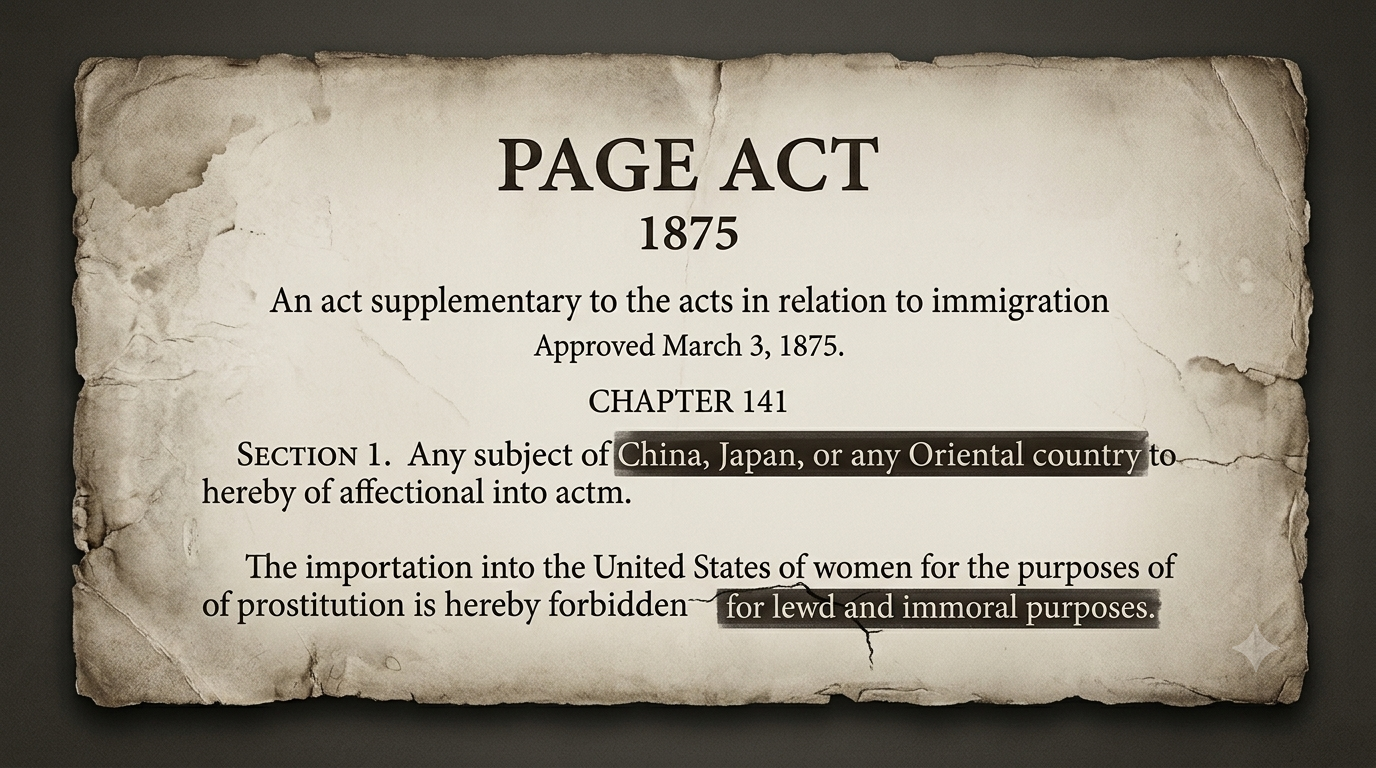
In 1875, Congress passed the Page Act, officially titled “An Act Supplementary to the Acts in Relation to Immigration.” The law prohibited the entry of any person coming to the United States “for lewd and immoral purposes” — language that named no group. Immigration officials applied it to one. Every Chinese woman arriving in the United States was presumed to be a prostitute. She had to prove otherwise to officials who had already decided the answer, using documentation most women could not produce. To enter, a Chinese woman had to secure a “certificate of character” from the U.S. Consul in Hong Kong, a process requiring grueling, hostile interrogations and photographs—a bureaucratic gauntlet deliberately designed for working-class women to fail.
The Page Act denied Chinese women entry as economic actors in their own right. Chinese women who would have immigrated were workers in laundries, domestic service, agriculture, and small commerce — the same sectors Chinese men occupied. Barring them shrank the labor force, reduced the household income that would have accumulated as property, and eliminated the wages and economic activity those women themselves would have generated. The Page Act dismantled that capacity before the Exclusion Act finished the job.
By 1880 — five years after the Page Act, two years before the Exclusion Act — an estimated 106,000 Chinese people lived in the United States. Fewer than 6,000 were women. One woman for every 17 men. That ratio was not a cultural artifact. It was the arithmetic consequence of the Page Act.
The Arithmetic of Exclusion
More Chinese men and women could not come. Chinese men and women who were already here could not become citizens. Without citizenship, Chinese immigrants could not vote, own property in most states, or access legal protections on equal terms.
The law called itself a labor regulation. It was a barrier to market entry—a legal constraint that excludes a group from competition. Stratification economics would identify the Chinese Exclusion Act as a strategy deployed by white immigrants to protect their economic position. Chinese workers in the 1880s were concentrated in mining, railroad construction, laundry, and domestic service — exactly where working-class white male immigrants competed directly. The Exclusion Act removed the competition. The Page Act had already removed the possibility of family formation that would have let the community grow.
In 1880, Chinese Americans were 0.38 percent of the U.S. population (see Figure 1). By 1900, after 18 years of exclusion, that share had fallen to 0.25 percent, even as the Chinese population reached its highest count in the exclusion era at about 113,000. By 1940, after 58 years of exclusion, the share had fallen further to 0.06 percent. Congress passed a law excluding a people from exclusion against a group that never exceeded 1/2 of one percent of the American population. The consequence of being labeled an economic threat is demographic erasure.
Figure 1. Chinese Adults as a Share of the U.S. Adult Population, 1880–2024
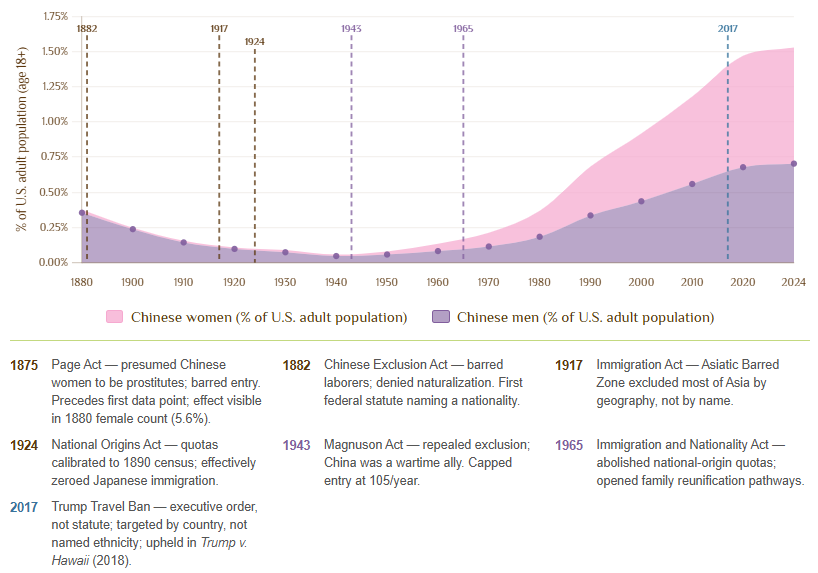
Source: Calculations by the Women’s Institute for Science, Equity and Race using IPUMS USA, weighted estimates (perwt), adults age 18+. Denominator: IPUMS-weighted U.S. adult total by census year. Decennial census 1880–2020; ACS 2024.
This erasure began in 1875 with the Page Act, which had been in effect for five years, so the percentage of Chinese women in 1880 was 5.6 percent of the Chinese population, lower than it would have been without the law (see Figure 2). By 1900, after 25 years of the Page Act and 18 years of the Exclusion Act running together, the female share had fallen further to 4.3 percent. The Page Act’s presumption did not end with the Chinese Exclusion Act in 1882, or with the Magnuson Act in 1943. Repealing the Exclusion Act reopened the door; it did not remove the presumption of immorality that the Page Act had written into statute for Chinese women specifically. That presumption remained on the books until the Immigration and Nationality Act of 1952 (McCarran-Walter Act) consolidated and superseded all prior immigration statutes.
Figure 2. Female Share of the U.S. Chinese Adult Population, 1880–2024

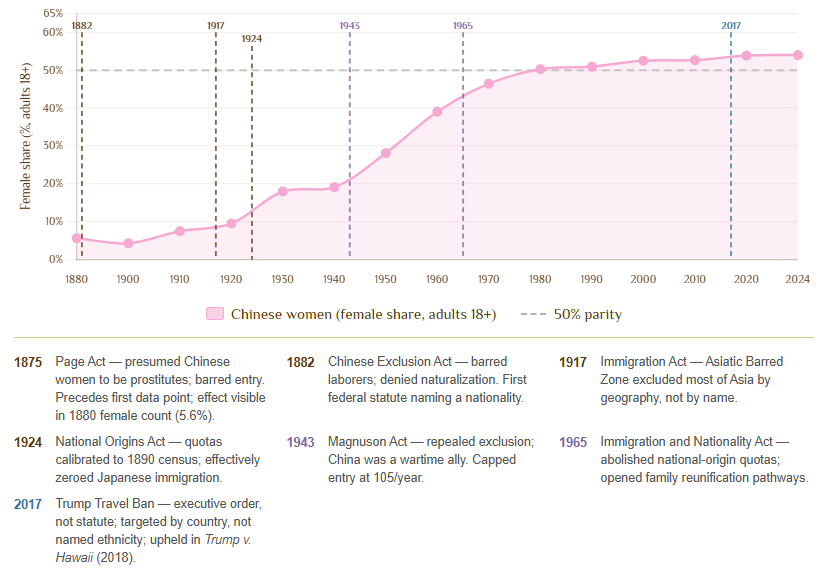
Source: Calculations by the Women’s Institute for Science, Equity and Race using IPUMS USA, weighted estimates (perwt), adults age 18+. Denominator: IPUMS-weighted U.S. adult total by census year. Decennial census 1880–2020; ACS 2024.
It took 77 years for Congress to recognize Chinese women as potentially moral immigrants. In those 77 years, Chinese women were denied the wages they would have earned, the property they would have accumulated, and the economic autonomy that was theirs to claim. That is the cost the Page Act extracted — not from America, but from Chinese women seeking to immigrate to these United States.
Not an Anomaly. A Template
The Exclusion Act was the first, but it was not the last.
The Immigration Act of 1917 drew a map. Congress called it the Asiatic Barred Zone — a geographic boundary that excluded immigration from virtually all of Asia without naming a nationality. When naming the people directly might invite constitutional scrutiny, geography does the work instead. The 1917 Act did not substantially change Chinese women’s position — they were already barred.
Immigration laws tracked power, not morality. Japanese women were allowed to enter under the Gentlemen’s Agreement of 1907, which excluded Japanese male laborers but preserved the right of wives to join their husbands. Between 1910 and 1920, Japanese women’s share of the U.S. population grew by 102.2 percent — while Chinese women’s share fell by 12.2 percent (see Figure 3). By 1920, Japanese women held a share of the U.S. population 7.4 times that of Chinese women. The difference was not morality. Japan had defeated Russia in 1905 and carried diplomatic leverage that China did not have in 1882. The Page Act’s presumption of immorality was applied to Chinese women because China had no government that could push back. When the diplomatic cost of exclusion rose, Congress found workarounds. When the cost was low, it put the name in the statute.
Figure 3. Chinese, Japanese, and Other Asian Women as a Share of the U.S. Adult Population, 1880–2024
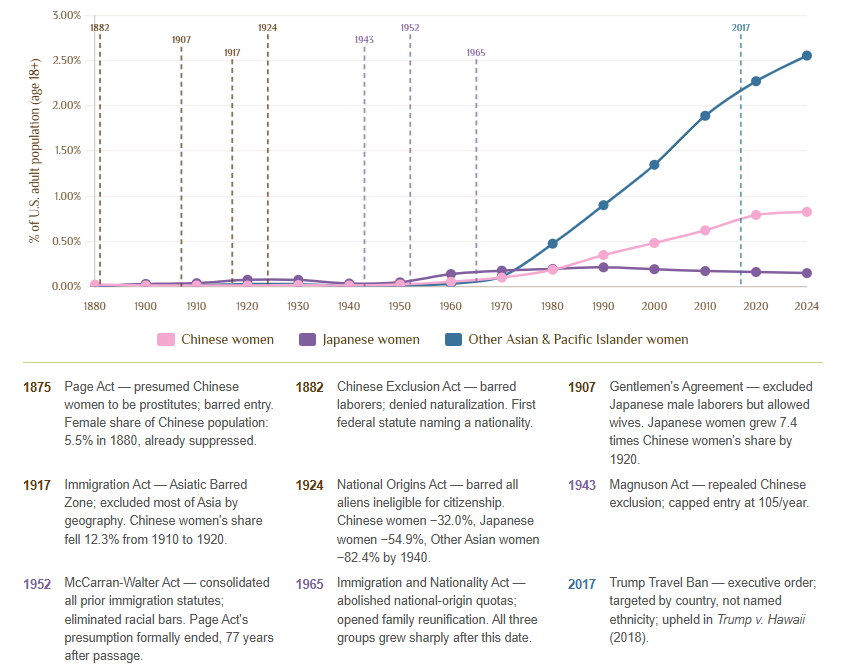
Source: Calculations by the Women’s Institute for Science, Equity and Race using IPUMS USA, weighted estimates (perwt), adults age 18+. Denominator: IPUMS-weighted U.S. adult total by census year. Decennial census 1880–2020; ACS 2024.
The Immigration Act of 1924 set national-origin quotas calibrated to the 1890 census — before South and East Asian immigration had any measurable scale — effectively zeroing out Japanese immigration. It encoded the existing racial hierarchy into arithmetic and called it policy. By 1940, the full effect was visible in the labor market. Chinese women’s share of the U.S. population fell by 32.0 percent from 1930 to 1940. The share of Japanese women fell by 54.9 percent. The share of other Asian and Pacific Islander women decreased by 82.4 percent (see Figure 3). The 1924 Act did not name Chinese women. It did not need to. It named a census year — 1890 — and let the arithmetic finish the job. Each group’s share of the U.S. labor market shrank while the market itself grew — competitive exclusion by statute.
The mechanism is recognizable across 135 years. You do not have to name the people to exclude them; you draw the right geographic lines or calibrate the right census year. What connects these laws is the willingness to use policy to determine who gets to belong, and the strategic erasure of women to ensure the targeted community cannot grow.
The Exclusion Act was repealed. The method was not. What history has taught us—from the criminalizing of religious groups to the criminalizing of immigrants from particular countries—is that if you can successfully label a group as foreign, suspect, and outside the boundaries of American belonging, you no longer need Congress to pass a law at all. Public discourse is enough to mark any community as a threat, do the work of exclusion for free, and dictate who gets to become an American.
Rhonda V. Sharpe is the president and founder of the Women’s Institute for Science, Equity and Race. Her research focuses on gender and racial inequality, the diversity of STEM, and the demography of higher education.