

On this day in 1965, the Voting Rights Act of 1965 was signed, which made discriminatory practices in voting illegal – literacy tests, poll taxes, intimidation, and violence. Civil rights and voting were among the five key pillars of the Great Society, and the War on Poverty, education, healthcare, and arts and culture were the others. As I reflect on the anniversaries of legislation aimed at creating a more equal and inclusive America, I am struck by the choice of the word “great” rather than “equal.”
I am not being naïve.
I am reflecting on a society that believes the progress of the 1950s and ’60s was grounded in America’s sense of morality, yet failed to name the agenda the “Equal Society.”
I am considering how Medicare and Medicaid expanded access to healthcare for millions of poor urban and rural Americans.
I know that the most vulnerable often become collateral damage in economic and political compromises.
I am mindful that today is also the 79th anniversary of the atomic bombing of Hiroshima.
I am contemplating my (our) responsibility for and accountability to society.
Just doing my job
Too often, researchers focus on the technical problems, which can overshadow questions of equity and justice. In Texas, Republicans are trying to redraw congressional districts to pick up five additional U.S. House seats, which would affect districts with a high percentage of vulnerable voters whose well-being is improved with support from federal programs like Medicaid (see Table 1).
Table 1. Demographics of Texas Congressional districts held by Democrats
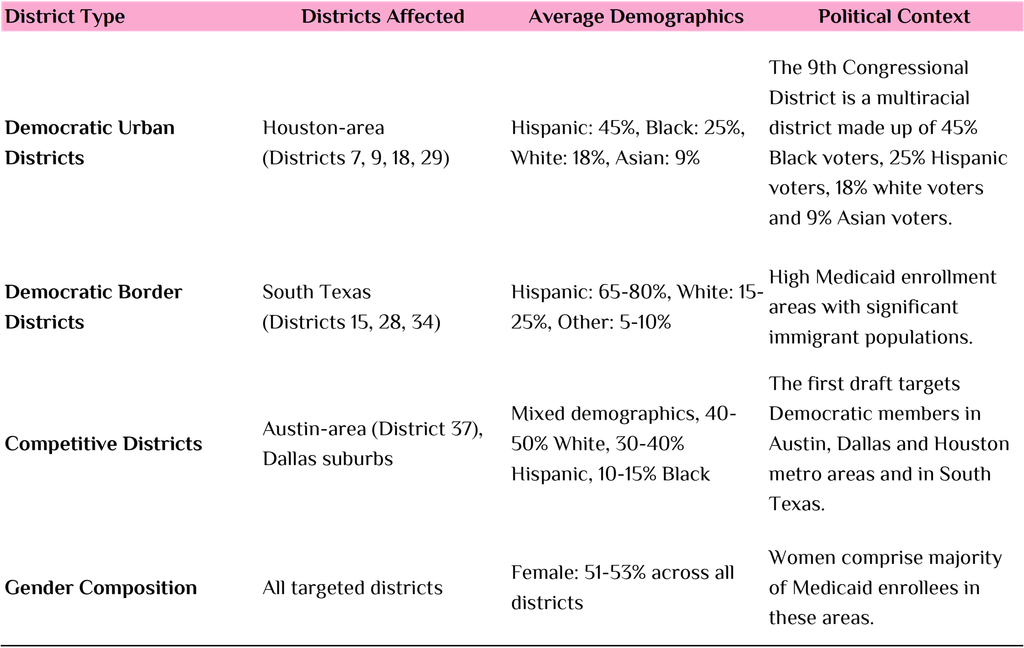
Data compiled from the U.S. Census Bureau 2023 American Community Survey, the Texas Demographic Center, and congressional district demographic profiles.https://data.census.gov/profile/Texas?g=040XX00US48
Texas House Democrats left the state Sunday in a bid to block a partisan redrawing of the state’s congressional map, thereby stalling passage of redistricting plans that would dilute minority voting power and reduce healthcare advocacy for vulnerable populations.
The connection to Medicaid policy is direct: These districts contain the highest concentrations of Medicaid beneficiaries in Texas, who would lose political representation under proposed redistricting. Unlike the Manhattan Project scientists, who didn’t consider their work’s implications, these Democratic lawmakers are actively challenging systems that would harm their constituents’ access to healthcare and political representation.
Creating a WISER Generation of Women
This August, we’re amplifying WISER’s critical work through our dedicated WISER Women campaign—and we need your support to make it happen.
Your $59 donation isn’t just a number – it’s a strategic investment in women’s leadership and policy research. Ready to be part of building a WISER generation of women? Visit www.wiserpolicy.org and make your $59 donation today.
When policy research is inclusive of all women, everyone benefits.
Rhonda V. Sharpe is the president and founder of the Women’s Institute for Science, Equity and Race. Her research focuses on gender and racial inequality, STEM diversity, and the demographics of higher education.