

Along with poverty data, the U.S. Census (Census) released income data. Many of you have probably seen the headline for the gap, but I’ll do a quick recap anyway. Women working full-time, year-round earned 83.9 cents for every dollar men earned, up from 80.6 cents in 2024. Bureau of Labor Statistics (BLS) data show the gender earnings gap at 82.1 cents in 2025, down from 82.7 cents in 2024. BLS and the Census differ (see Figure 1) because the samples differ. BLS measures median weekly earnings among full-time workers, excludes the self-employed, and does not restrict the sample to year-round employment. Which is correct? Kim Elsesser notes that year-over-year data fluctuates and that long-term trends are the appropriate metric. The aggregate data for “women” shows the gap is decreasing.
Figure 1. Comparison of Census Bureau and Bureau of Labor Statistics Gender Earnings Ratios: 2024–2025
Neither tells you what happened to the earnings gap for a specific group of women, Asian mothers, Black single women, Hispanic women with BS+ education; you get the idea. Given that poverty and income are highly correlated, and the poverty rate for Hispanics decreased from 15.1% in 2024 to 13.9% in 2025, I examine the earnings gap for full-time, year-round workers, Hispanic women, disaggregated by age and educational attainment.
While the default comparison in policy research is to calculate the gap relative to White, non-Hispanic men, our analysis calculates three earnigs gaps: economy-wide, intra-ethnicity, and intra-gender. For years, I have questioned why wage inequality uses White, non-Hispanic men as the benchmark. I often hear that it is because they comprise the largest share of the workforce. But that response assumes that White, non-Hispanic men’s labor market outcomes represent neutral baseline parity; hence, every other group’s outcome is a deviation from that standard. I am not convinced that’s true. Furthermore, I remember Tony Brown saying that, with respect to education, he wanted the goal pegged to the group with the highest educational achievement. I assert the same for earnings. The gap should be based on the group with the highest earnings. To benchmark education or earnings to “Whites” for political or convenience is to suggest doing as well as White, non-Hispanic men (Whites) is “good enough.” Census and Bureau of Labor Statistics data find that Asian men typically report higher median annual earnings at bachelor’s and advanced degree levels. However, White, non-Hispanic men comprise 30% to 35% of the full-time, year-round workforce.
Our analysis does not compare Hispanic women to White, non-Hispanic men. We compare Hispanic women to Hispanic men, not as an alternative “norm,” but as an intentional methodological choice to isolate how gender operates within an ethnic group and to avoid conflating racial/ethnic occupational sorting with intra-gender inequality. Additionally, we calculate the earnings gap for Hispanic women versus all workers and versus all women to isolate the economic consequences of ethnicity and gender occupational sorting. Degree levels and earnings are suppressed if the estimated population base fell below 75,000 weighted individuals.
However, before calculating earnings, we calculated the share of Hispanic women with earnings who worked full-time, year-round in 2025 (see Table 1). Our sample is limited to full-time, year-round earners because across prime working ages (25–54), roughly 70% of working Hispanic women work full-time, year-round. This rate is similar to that for all working women (72% to 75%) but is 10 to 12 percentage points lower than the rate for Hispanic men (80% to 83%).
Table 1. Share of Hispanic women 25 to 64 who work full-time, full-year: 2025
The Three Benchmarks
We begin with the earnings gap of Hispanic women vs. all workers. Across all four age cohorts, the ratio of Hispanic women’s median earnings to all workers’ median earnings is lowest among bachelor’s degree holders, 63% ($57,460 vs. $90,500) for women ages 55–64. That is a $33,000 gap in the years when earnings should be their highest. Young Hispanic women (25–34) with a bachelor’s degree earn 83% of the all-worker benchmark, $60,570 vs. $73,080. Hispanic women have a lower wage-earnings gap in the “some college, no degree” category among 25–34-year-olds (95%) and in the master’s degree category among 35–44-year-olds (97%). The smaller earnings gap among younger Hispanic women reflects generational shifts, higher shares of U.S.-born workers with domestic credentials, and expanded access to entry-level professional jobs that have compressed wage structures. However, the compounding penalties of occupational segregation, promotion barriers, and caregiving widen as workers move toward mid-career — the larger earnings gap for older Hispanic women.
Table 2. Earnings Gap for Hispanic Women vs. All Workers: 2025

Source: Table PINC-03: Educational Attainment—People 25 Years Old and Over by Total Money Earnings in 2025, Work Experience in 2025, Age, Race, Hispanic Origin, and Sex
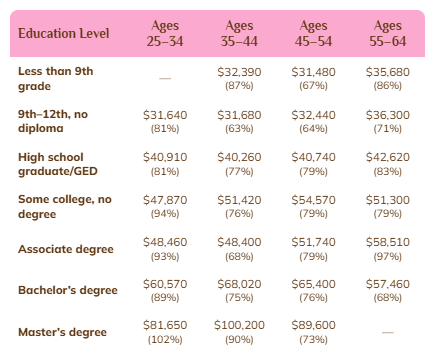
The intra-ethnic earnings gap is greatest in early- to mid-career, potentially explained by the compounding penalties of caregiving, which lead to tenure disruptions and reduced work experience. For ages 25–34, Hispanic women with associate or bachelor’s degrees earn 93% and 89% of Hispanic men’s median earnings. By ages 35–44, that ratio is 68% for associate degree holders ($48,400 vs. $70,720) and 75% for bachelor’s degree holders ($68,020 vs. $90,970), a 25- and 14-percentage-point decrease, respectively. Hispanic women ages 25–34 with a master’s degree earn parity with Hispanic men (102%, $81,650 vs. $80,060), but that advantage disappears in older cohorts, decreasing to 90% at ages 35–44 and 73% ($89,600 vs. $122,000) at ages 45–54.
Among Hispanic workers without a high school diploma, Hispanic women earn just 63% to 64% of Hispanic men’s median earnings in the prime working years of ages 35–54 ($31,680 vs. $50,040 at ages 35–44, and $32,440 vs. $50,360 at ages 45–54). This 36- to 37-point intra-ethnic penalty reflects occupational sorting. Non-degreed Hispanic men are concentrated in construction, logistics, and manual trades that offer overtime pay and higher hourly rates. In contrast, non-degreed Hispanic women are crowded into domestic work, commercial cleaning, food service, and personal care aide occupations where wages are often anchored to state and federal minimums, overtime is scant, and tenure does not offer wage growth.
Table 3. Intra-Ethnicity Earnings Gap for Hispanic Women vs. Hispanic Men: 2025

Source: Table PINC-03: Educational Attainment—People 25 Years Old and Over by Total Money Earnings in 2025, Work Experience in 2025, Age, Race, Hispanic Origin, and Sex
Our analysis of Hispanic women compared to all women finds that gender operates differently across race and ethnicity. For example, while Hispanic women with a high school diploma earn 98% of the all-women high school median at ages 25–34, Hispanic women with a bachelor’s degree earn 91% or less of the all-women benchmark across every single age category. For Hispanic women ages 55–64 with a bachelor’s degree, the earnings gap is $18,600, 76% of what all women with a bachelor’s degree earn ($57,460 vs. $76,060). Across cohorts, the earnings ratio decreases by 15 percentage points, from 91% at ages 25–34 down to 76% at ages 55–64. In contrast, among workers with some college but no degree, Hispanic women achieve rough parity with all women (104%, 100%, and 102% across ages 25–54). Yet once a four-year degree is achieved, ethnic occupational sorting and glass-ceiling barriers widen the gap, leaving Hispanic women earning just 87% to 91% of all women’s earnings through their prime earning years.
Table 4. Intra-Gender Earnings Gap for Hispanic Women vs. All Women: 2025

Source: Table PINC-03: Educational Attainment—People 25 Years Old and Over by Total Money Earnings in 2025, Work Experience in 2025, Age, Race, Hispanic Origin, and Sex
Benchmarking earnings equity to White men obscures how gender operates and treats racial privilege as the goalpost. But collapsing all women into a single aggregate treats women as a monolith and can create the illusion of progress. Policy solutions that rely exclusively on “upskilling” and educational attainment may not close the earnings gap. We must couple workforce development with equal pay enforcement, pay transparency legislation, and workplace desegregation to target the specific occupational and credential sorting. Otherwise, education and skill development will remain a hollow promise of equity.
Stay sharp and question the benchmark.
Rhonda V. Sharpe is the president and founder of the Women’s Institute for Science, Equity and Race. Her research focuses on gender and racial inequality, STEM diversity, and the demographics of higher education.