
Last week, the Today Show ran a promo for NBC News’ “Great Americans” series, marking the United States’ 250th anniversary, featuring an interview with Michael Phelps. I asked my parents at breakfast, “I wonder if they are interviewing any Black people?” My mother asked, “What do you love about America?” (I am my mother’s child.) I said I didn’t know, but I would think about it.
What I love about these United States is the failure to deliver on the promises of the Constitution and the Bill of Rights—and how Americans organize and advocate to make those promises real, generally without threat to life or liberty. When there is a threat to life or liberty, some have organized and advocated anyway. Some paid with their lives and their freedom so I could grow up free and pursue my happiness. I also love how hypocrisy is often the thread that connects the patchwork of unfulfilled promises. My belief that America will one day fulfill its promises fuels my commitment to diversity, equity, and inclusion, and my conviction that these are necessary to maximize opportunity for all Americans.
That same love, hope, and conviction shape how I see Earth Day. Every April 22, we are invited to celebrate “the planet” by planting a tree, recycling, and sharing a hashtag. While these actions may help the Earth, they do little, if anything, to protect those who are paid to safeguard our air, water, and land. My belief in America also demands that I ask who is protected, who is exposed, and who is paid to carry the burden of environmental protection. This Earth Day, I honor the women employed to protect our air, water, and land by providing data on their representation in environmental and conservation occupations and their median earnings.
Earth First, Equity Second
Women accounted for 42% of workers in environmental and conservation occupations. They were nearly equal to men in the “physical scientists, all other” category, which includes crystallographers, mineralogists, hydrographers, and materials physicists (see Table 1). To understand where women are employed and how they are compensated, we next focus on the top two environmental and conservation occupations.
Table 1. Distribution of environmental and conservation occupations by sex Source: Calculations by the Women’s Institute for Science, Equity and Race using 2024 American Community Survey, www.ipums.org.
Chemists and materials scientists are more likely to be employed in the private sector (86%) (see Table 2). Women are 37% of those employed in the private sector and 53% of those employed in local government. Sixty percent of Asian women employed in the private sector have advanced degrees, but earn 87 cents per dollar compared to the median wage for all workers. For Black women employed as chemists and materials scientists, 81% have bachelor’s degrees, and 45% are employed in the private sector, followed by 35% in state government. Black women chemists and materials scientists employed by the state earn $1.05 for every dollar the median worker earned, nearly twice what Black women in the private sector earn—54 cents for every dollar the median worker earned.
Table 2. Chemists and materials scientists by race, ethnicity, and employer type Source: Calculations by the Women’s Institute for Science, Equity and Race using 2024 American Community Survey, www.ipums.org.
Hispanic women chemists and materials scientists with a bachelor’s degree are concentrated in the private sector (74%)y and earn 92 cents for every dollar earned by the median BS-level private-sector worker (see Table 2). At the graduate level, Hispanic women earn roughly 90 cents per dollar in private-sector positions and about 71 cents per dollar in federal employment. Multiracial women account for approximately 1.3% of the chemistry and materials science workforce. Those with a bachelor’s degree and in the private sector earn approximately $1.55 for every dollar earned by the median BS-level private-sector worker. This premium does not extend to federal employment, where Multiracial women with a bachelor’s degree earn about 67 cents on the dollar. Multiracial women with advanced degrees n the private sector earn approximately 88 cents per dollar. Indigenous American women chemists and materials scientists make up approximately 0.1% of the private-sector workforce. Those without a bachelor’s degree earn approximately 66 cents for every dollar earned by the median less-than-BA private-sector worker, and among those with graduate degrees, the median wage is extremely high, which likely reflects small cell sizes rather than broad access to high-paying jobs.
To understand whether these patterns extend beyond chemistry and materials science, I next examine women employed as physical scientists.
Physical scientists, women with a bachelor’s degree, are concentrated in the private sector, where they earn less than the median worker. …Physical scientists, women with a bachelor’s degree, are concentrated in the private sector, where they earn less than the median worker. For example, at the BS level, women overall earn about 95 cents for every dollar earned by the median worker in the private sector and 96 cents on the dollar in federal employment (see Table 3). Hispanic women physical scientists with a BS employed in the private sector earn about 98 cents per dollar compared with the median worker, and those employed by state government earn roughly 98 cents per dollar as well; hence, their wage penalty is small but persistent across employer types. Multiracial women with a BS and employed in physical sciences occupations earn about $1.01 for every dollar earned by the median worker in the private sector, but only 93 cents on the dollar in federal jobs. Indigenous American women physical scientists are present in very small numbers; those with a BS in the private sector earn roughly 99 cents per dollar compared with the median worker, and among graduate‑educated Indigenous women, the median wage is extremely high, which likely reflects small cell sizes rather than higher compensation.
Table 3. Distribution of physical scientists by race, ethnicity, and employer type
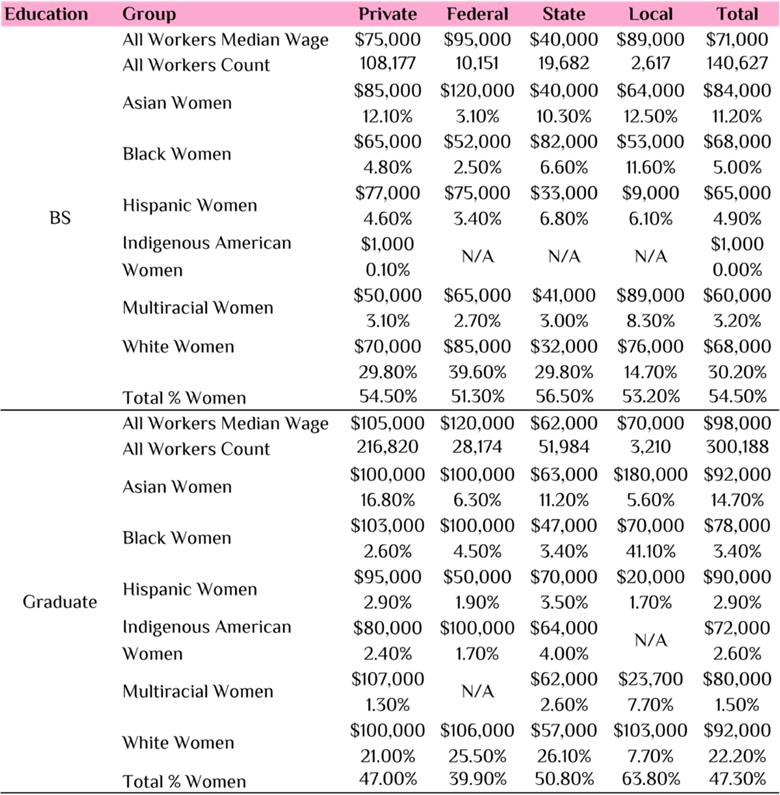
Asian and Black women physical scientists, with bachelor’s and graduate degrees, are in the same occupation but have different earnings relative to the median worker. Asian women with a bachelor’s degree employed in physical science jobs are concentrated in the private and federal sectors and earn 90 to 95 cents per dollar in the private sector and similar levels in federal employment, despite their higher rates of advanced degrees. Black women with a bachelor’s degree in physical science roles earn less than the median worker in the private sector, approximately 60–70 cents on the dollar, and only a small share in high‑pay federal positions come close to or exceed parity with the median worker.
The representation and earnings data for women in environmental and conservation occupations reinforce what we already know: the “green economy” is built on the same unequal labor market that structures every other sector. Asian, Black, Hispanic, Indigenous American, and Multiracial women are doing the work of protecting our air, water, and land, but too often they are paid less than other workers, and their access to the highest‑paid roles is constrained by employer type as well as credentials. It is important to note that within these occupations, women are not similarly situated: wage penalties and access to higher‑paid positions differ sharply by race and ethnicity. This is the hypocrisy Earth Day does not advertise — a movement founded on the promise that all people have a moral right to a healthy environment, built in part on the underpaid labor of the women most responsible for delivering it.
What I love about America is that I can call it out. I have provided the data. Policymakers, employers, and advocates who are serious about the moral promise of Earth Day have what they need — use it. Move beyond tree‑planting photo ops. Dismantle the occupational segregation and pay penalties that undercut the very women whose labor sustains environmental protection. Enforce pay‑equity laws by occupation and employer. Ensure that climate and conservation funding explicitly accounts for who is hired, how they are paid, and what advancement looks like.
Rhonda V. Sharpe is the president and founder of the Women’s Institute for Science, Equity and Race. Her research focuses on gender and racial inequality, the diversity of STEM, and the demography of higher education.