

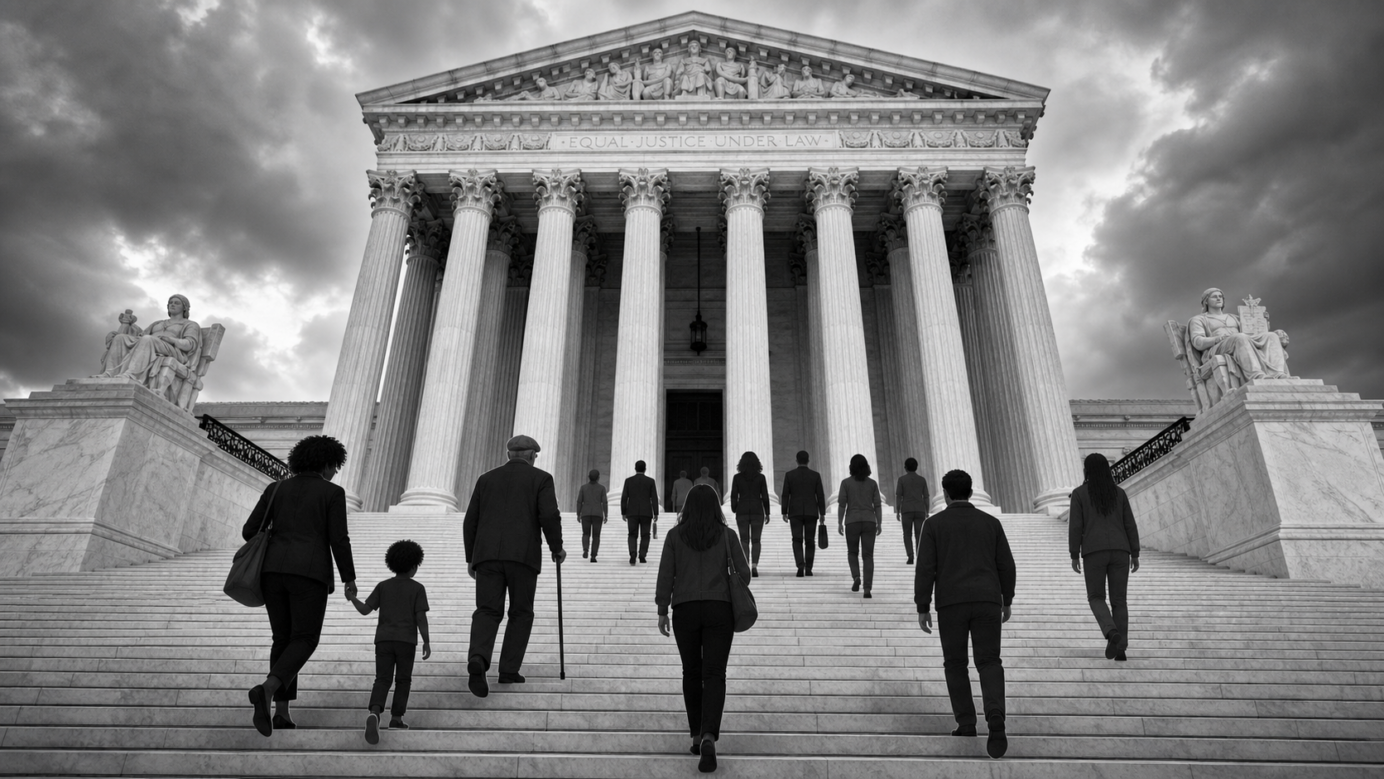
Today marks the 4th anniversary of Dobbs v. Jackson Women’s Health Organization, in which Justice Samuel Alito, writing for the majority, evaluated abortion access using a strict historical test, concluding that:
“The Constitution makes no reference to abortion, and no such right is implicitly protected by any constitutional provision… any such right must be ‘deeply rooted in this Nation’s history and tradition’ and ‘implicit in the concept of ordered liberty.’ … The right to abortion does not fall within this category.” Dobbs v. Jackson Women’s Health Organization, 597 U.S. 215 (2022).
I wrestle with the conflict between that ruling and the promise Thomas Jefferson wrote into the Declaration of Independence — that all persons are endowed with the unalienable right to life, liberty, and the pursuit of happiness. If I cannot make unabridged decisions about my own body, how can I pursue happiness?
I continue with what I love about these United States: the willingness of Americans to amend the Constitution — to admit, in writing, that historical practices (or history) were wrong. What I find absurd — and I use that word precisely — is the use of the very history those amendments confessed to as the justification for restricting the rights they were written to protect. That is precisely what the majority did in Dobbs.
It is ironic that Justices Thomas and Barrett voted that abortion was not protected because it did not fit within the historical context and traditions — apparently forgetting that neither a Black man nor a white woman sitting on the Supreme Court fits within that same historical context. Dred Scott v. Sandford (1857) held that Black people had no rights the Constitution was bound to protect. Bradwell v. Illinois (1873) upheld the exclusion of women from the practice of law.
Five of the justices—Samuel Alito, Clarence Thomas, Brett Kavanaugh, Amy Coney Barrett, and Neil Gorsuch (who was raised Catholic but attends an Episcopal church)—voted to overturn Roe entirely, while Chief Justice John Roberts, who is Catholic, concurred in the judgment to uphold Mississippi’s 15-week ban but wrote a separate opinion explicitly stating he would not have overturned Roe. Historically, anti-Catholic sentiment shaped American law and politics and excluded Catholics from civic life. Chief Justice Roger Taney, the first Catholic justice (confirmed in 1836), wrote the Dred Scott decision in 1857, holding that Black people had no rights the Constitution was bound to protect. The first Catholic on the Court used his seat to deny Black Americans the constitutional personhood the Fourteenth Amendment would later have to correct.
And yet, here we are — because Americans have always organized to close the gap between the Constitution’s promises and its practice.
This email is written in honor of the colonists — farmers, tradesmen, and merchants who organized in taverns and meetinghouses, who launched the American Revolution. These ordinary people fought for the chance to create a government that would represent them. They boycotted British goods, dumped 342 chests of British tea into Boston Harbor, disrupted colonial courts, formed shadow governments, and took up arms against British colonial rule.
They won.
Without them, there would be no United States of America.
No Constitution.
No me — beautifully made from all the imperfections and hypocrisies of this country and its Constitution.
And in honor of those who have lived by the Preamble to the Constitution:
We the People of the United States, in Order to form a more perfect Union, establish Justice, insure domestic Tranquility, provide for the common defence, promote the general Welfare, and secure the Blessings of Liberty to ourselves and our Posterity, do ordain and establish this Constitution for the United States of America. [for my Boomers and Gen Xers — Schoolhouse Rock]
Cost-Benefit Analysis
Like the colonists, ordinary people have organized to make the United States a more perfect union. The suffragettes were teachers, factory workers, mothers, and farmers’ wives who wanted what the Constitution promised and had been told did not apply to them. The argument against them was that women belonged in the home, not the ballot box. For 132 years after ratification, the Constitution’s promise of liberty did not include the right to vote for women. They organized for 72 of those years — from the Seneca Falls Convention in 1848 to the 19th Amendment in 1920 — picketing and getting arrested. In 1917, when President Wilson asked Congress to declare war on Germany to make the world safe for democracy, women ran the country’s factories and farms but could not vote. That same year, revolutionary Russia — the country America feared most — extended the vote to women. Congress passed the Amendment in 1920, not because the government agreed with the principle, but because the cost of being seen as less democratic than a communist revolution exceeded the cost of the vote. But for Black women, Indigenous women, and Hispanic women, the 19th Amendment was a promise on paper — poll taxes, literacy tests, and intimidation kept them from the ballot for decades more.
Civil rights advocates were domestic workers, students, ministers, and sharecroppers who wanted the Constitution’s promise applied without conditions. They tried negotiating through the courts, through Congress, through every civic channel the Constitution said was available to them. That negotiation was met with systemic violence — fire hoses, dogs, bombings, beatings, murder, and lynchings. The killing of Black Americans was a cost the South was willing to pay. It had been paying it for centuries. What became expensive was not the violence, but the visibility of American brutality.
Mamie Till-Mobley insisted on an open casket for her son, Emmett Till, so that the world could see the brutality. The photographs ran internationally. In 1963, a bomb placed by the Ku Klux Klan at the 16th Street Baptist Church in Birmingham killed four girls preparing for Sunday school. The dogs and fire hoses in Birmingham. The beatings on the Edmund Pettus Bridge in Selma. All of the brutality and oppression were broadcast domestically and internationally. The Soviet rebroadcasts reached audiences in Asia, Africa, and South America with a simple retort to every American criticism of Soviet human rights: “And you are lynching Negroes.” The Cold War made American apartheid a Soviet propaganda gift. That was not a Southern cost. That was a cost America — and American foreign policy — was unwilling to pay.
For Public Good
In 1967, Dr. Martin Luther King Jr. and the Southern Christian Leadership Conference began organizing the Poor People’s Campaign — a multiracial coalition of Black Americans, Indigenous Americans, Hispanic Americans, and poor white Appalachians who had watched the Civil Rights Act pass and discovered that legal freedom did not pay rent. Their argument was direct: political rights without economic rights are incomplete. A century after emancipation, the Constitution guaranteed liberty but not the material conditions to exercise it. They came to Washington in the spring of 1968 to demand an Economic Bill of Rights — jobs, housing, and the extension of existing federal programs to the people they had always excluded. Dr. King was assassinated on April 4, 1968, before the campaign reached Washington. Ralph Abernathy led it in his place. Three thousand people lived in tents on the National Mall for six weeks. On June 19, Coretta Scott King spoke to fifty thousand people at Solidarity Day. Five days later, on June 24, 1968, the federal government sent bulldozers. Resurrection City was leveled. The Economic Bill of Rights never passed.
One of its six demands was the adoption of the pending Housing and Urban Development Act of 1968 — a plan to provide affordable housing by building subsidized units and lowering mortgage costs for low- and moderate-income families. This week, Congress passed the 21st Century ROAD to Housing Act to achieve the same goal through different means: restricting large institutional investors from buying single-family homes, reducing regulatory barriers to new construction, expanding rental assistance, and making manufactured homes cheaper to build.
Federal housing policy has always been a question of who the government decides deserves to move in.
The 21st Century ROAD to Housing Act passed the Senate 85–5 and the House 358–32. In contracting, when a building is complete and approved, but the certificate of occupancy is withheld until an unrelated dispute is resolved, the people waiting to move in pay the cost of someone else’s negotiation. As of this writing, the signature has been withheld — conditioned on Congress passing the Safeguarding American Voter Eligibility (SAVE) America Act, which would require documentary proof of citizenship and photo ID to register to vote in federal elections. The Constitution gives the president 10 days to sign or veto. If he does neither, the bill becomes law without his signature.
Tick tock.
The Declaration of Independence — the document the colonists who opened this email fought and died for — listed as its first grievance against the king:
“He has refused his Assent to Laws, the most wholesome and necessary for the public Good.”
That was 1776. The demand that the government honors its obligations to the people it was created to serve has not changed.
Neither has the conflict at the center of this email. The Constitution promises liberty. The Declaration promises the pursuit of happiness. Bodily autonomy is not incidental to either. The same logic that says housing is not a partisan question should extend to access to the full suite of health care.
Rhonda V. Sharpe is the president and founder of the Women’s Institute for Science, Equity and Race. Her research focuses on gender and racial inequality, the diversity of STEM, and the demography of higher education.