

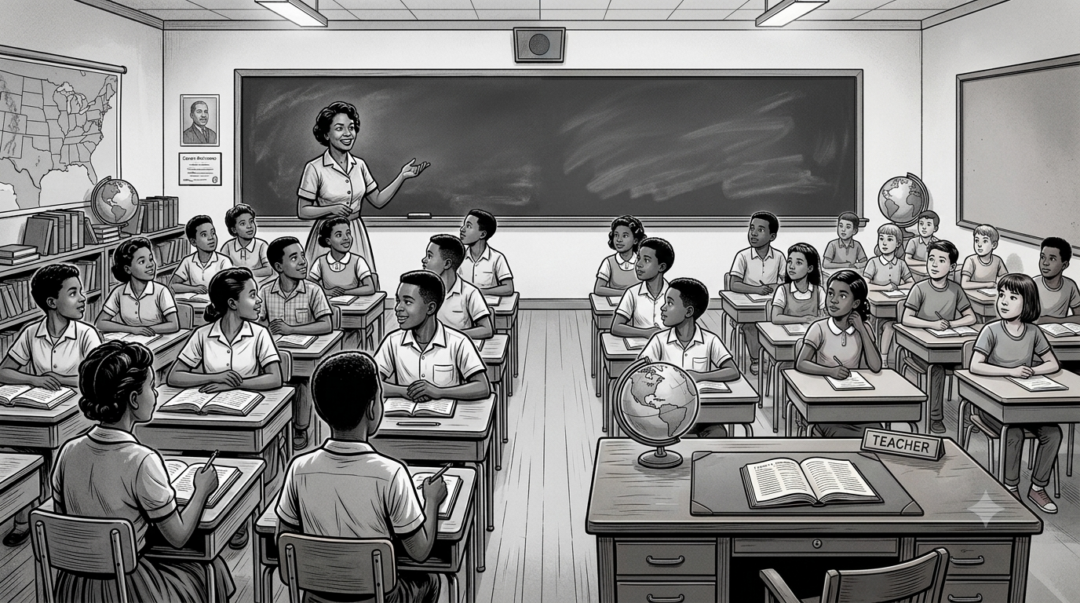
Why is it that watching others achieve life milestones makes us reflect on our lives? This graduation season, I look at the diversity of faculty, teachers, and students (or lack thereof), and I think about how different my educational experience would have been if my parents had moved from Harlem, New York, to Henrico County, Virginia.
In Harlem, I attended Public School 154, Harriet Tubman Learning Center, and my kindergarten and first-grade teachers were Black. Aside from my parents, these women were in a position of influence: whether I believed I was intelligent, smart, and capable.
At 7, we moved to Virginia.
Although I had aunts who taught at the primary level and an uncle who had taught at the primary and middle school levels—all in the South—I would not have another Black teacher until high school—biology and PE. I would be in graduate school before I understood the consequences of Brown for Black teachers.
This is the 6th of 10 essays on why I love these United States. I love that, though education is not explicitly stated in the U.S. Constitution, the 14th Amendment has been used to expand access (Brown v. Board of Education and Regents of the University of California v. Bakke) and restrict access (Students for Fair Admissions v. Harvard). I love that the tension between lived experiences, education, and equal protection can shape how the law is applied. Moreover, I’d argue that when justices are educated at similar institutions, that tension may not keep Lady Justice’s scales balanced.
So today, on Elizabeth Koontz’s birthday, the first Black president of the National Education Association—the organization Congress chartered in 1906 to advance American public education—I honor teachers, especially those who too often work in a “separate and unequal” educational system.
Education is Economic and Social
In graduate school, I learned that education was a merit good:
Private goods that could be offered through the private market but are offered or financed through the political market because citizens believe that if they are left solely to private markets, some people would not consume a sufficient quantity of such goods. [Johnson, Public Choice: An Introduction to the New Political Economy, p. 110]
This definition explains why education policies are shaped by economics and social values.
I’d long believed that Plessy v. Ferguson was the legal foundation for “separate but equal” in schools. But an astute referee informed me that it was Gong Lum v. Rice. The case was brought by Martha Lum, a nine-year-old born in the United States, who was removed from her Mississippi school at noon recess because she was “of Chinese descent, and not a member of the white or Caucasian race.”
Her father sued.
He lost, unanimously.
The Court held that classifying a U.S.-born Chinese citizen as “colored” did not violate the Constitution so long as facilities were nominally equal.
Early in my career, I’d challenge scholars who’d aggregate Asians and white test scores. I’d say, but they are not white, so you are inflating the white score. They’d reply, we know. But the sample is so small. So why not aggregate Black or Hispanic groups, or create a non-white category? After all, the U.S. Supreme Court ruled a Chinese citizen was “colored.”
But I digress.
Despite Kansas being the first state for Brown, Southern Confederate states are often thought to be the sole proponents of “separate but equal.” This is false. Twenty-four of America’s 50 States and the District of Columbia allowed school segregation (see Table 1).
Table 1. School Segregation Law, Education Quality, and Student Diversity Change by State

EdWeek grades measure school finance, achievement on the National Assessment of Educational Progress, and graduation rates. They do not measure integration. A state can receive a B+ while remaining among the most racially segregated in the country. By 2022, 21 of the 25 states had student bodies that were majority nonwhite. Yet the national teacher workforce remained majority white; 71% of positions (see Table 2). District of Columbia was 96% nonwhite students in 1986 and 86.8% in 2022 — the only jurisdiction showing a decline in nonwhite share.
Table 2. Teachers and students, 1960–2024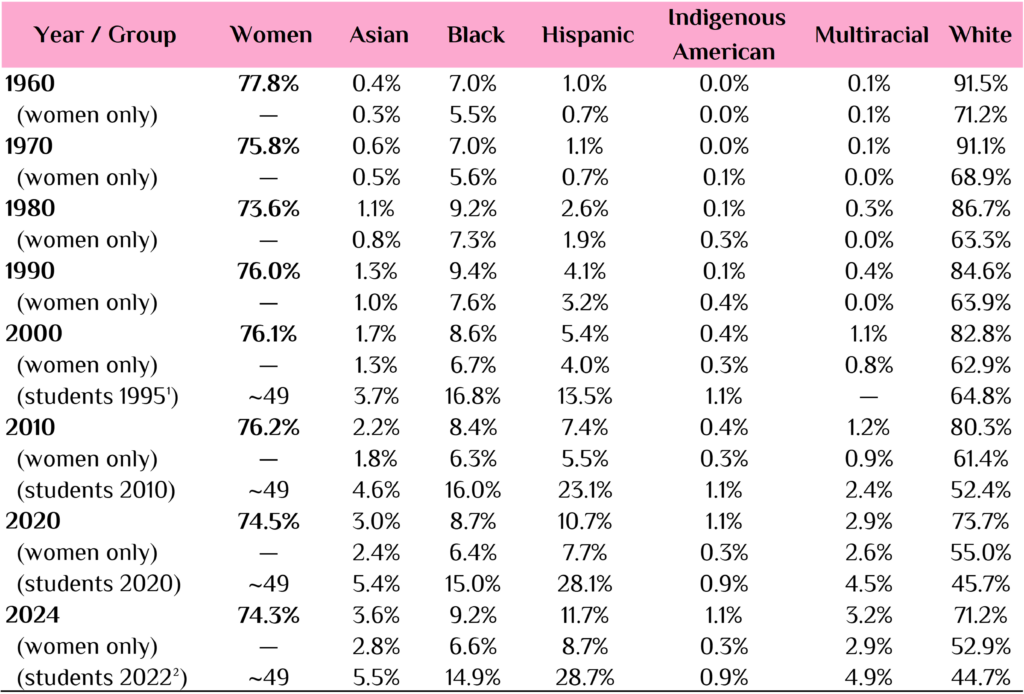
Education is a Merit Good
Elizabeth Koontz did not wait for the courts. She used the NEA—the institution—to push from within. As president, she led the NEA’s endorsement of the Kerner Commission report, which named white racism as the cause of urban unrest. She then became the first Black director of the Women’s Bureau at the U.S. Department of Labor under Nixon, where she fought for equal pay.
Advocacy from within institutions now faces growing challenges. In early 2025, cuts to education research contracts disrupted data collection on school safety, early childhood education, and students with disabilities. Federal K–12 funding was temporarily withheld before being restored. Meanwhile, the NEA remains the target of ongoing legislative efforts—including a pending 2025 bill—aimed at stripping it of its congressional charter.
Roughly one in eight teaching positions in 2025 is either unfilled or filled by someone not fully certified for the assignment. Thirty-one percent of AI experts expect artificial intelligence to lead to fewer teacher jobs over the next 20 years. The Valley Leadership Academy in Bacup, Lancashire, is already running the experiment using a remote teacher 300 miles away. Members of the National Education Union voted to strike on December 3, 10, and 11, and on January 6–8, over the arrangement.
The children most likely to lose a human teacher to a screen are not in well-resourced suburban districts. Equity in who teaches is a labor market question, a legal question, and now a technology question.
What I love about America are the Elizabeth Koontzes—the Americans who understand that the hypocrisy of our founding fathers does not have to be the eternal fate of this nation and who work every day to ensure we are the country we say we are.
Rhonda V. Sharpe is the president and founder of the Women’s Institute for Science, Equity and Race. Her research focuses on gender and racial inequality, the diversity of STEM, and the demography of higher education.