

People often quote “What, to the American slave, is your 4th of July?” by Frederick Douglass, but rarely do they offer his response.
I answer: a day that reveals to him, more than all other days in the year, the gross injustice and cruelty to which he is the constant victim. To him, your celebration is a sham; your boasted liberty, an unholy license; your national greatness, swelling vanity; your sounds of rejoicing are empty and heartless; your denunciations of tyrants, brass fronted impudence; your shouts of liberty and equality, hollow mockery; your prayers and hymns, your sermons and thanksgivings, with all your religious parade, and solemnity, are, to him, mere bombast, fraud, deception, impiety, and hypocrisy— a thin veil to cover up crimes which would disgrace a nation of savages. There is not a nation on the earth guilty of practices, more shocking and bloody, than are the people of these United States, at this very hour.
— Frederick Douglass (1852, p. 7)
I am struck by how many historical documents describing the social strife in America could have been written yesterday.
The Declaration of Independence contains two sentences that define America’s relationship with itself. The first is that “all men are created equal, that they are endowed by their Creator with certain unalienable Rights, that among these are Life, Liberty, and the pursuit of Happiness.” The second is listed among the grievances against King George: the founders wrote that he had “excited domestic insurrections amongst us, and has endeavored to bring on the inhabitants of our frontiers, the merciless Indian Savages, whose known rule of warfare, is an undistinguished destruction of all ages, sexes and conditions” (Declaration of Independence, 1776).
The promise of equality required the simultaneous dehumanization of the people whose land was needed and the people whose labor was needed. The enslaved built the economy on land confiscated from Indigenous peoples who owned the land. The Declaration did not include them in its promise. It named them as a threat to that promise.
The Constitution ratified eleven years later was no more inclusive. The Three-Fifths Compromise counted each enslaved person as three-fifths of a human being — not to give them representation, but to give their enslavers more seats in Congress. In 1857, the Supreme Court in Dred Scott v. Sandford codified what the founders had implied: Black people, free or enslaved, were “not included, and were not intended to be included, under the word ‘citizens’ in the Constitution.” They were born here. They owed allegiance to the government. They were still not citizens.
The 14th Amendment, ratified in 1868, was the correction — written explicitly for the formerly enslaved. “All persons born or naturalized in the United States” are citizens. Full stop, right? No. The Senate Judiciary Committee ruled in 1870 that the 14th Amendment had “no effect whatever upon the status of Indian tribes” (Constitution Center, 2023). The Indian Citizenship Act did not pass until 1924. The Indigenous people who had been on this land since before any document existed were the last to be formally included in those documents (Northwestern University Institute for Policy Research, 2024).
This is the 10th and last essay in my series on why I love these United States. What I love this week is that the Court’s two Black justices — both of whom needed the 14th Amendment to be recognized as citizens — could hold such different ideologies in the same case. One defended exclusion. One called out the hypocrisy. If anyone still believes Black people are a monolith, Thomas and Jackson are the counterexample.
Justice Clarence Thomas, in dissent, invoked Frederick Douglass himself to argue that the 14th Amendment was written for people who were born here and called it home — not for children of temporary visitors. Thomas wrote that the Citizenship Clause was enacted for men such as Douglass, who demanded citizenship “not as aliens nor as exiles,” but as “Americans” — people who, unlike temporary visitors, “owe equal allegiance to the same government” (Trump v. Barbara, 2026; Douglass, 1852). Therefore, Thomas concluded, the Amendment does not extend to children of undocumented immigrants or temporary visitors:
The Citizenship Clause was enacted for people who were born in this country and called it home. It was enacted for freed slaves such as Dred Scott … It was enacted for men such as Frederick Douglass, who demanded citizenship “not as aliens nor as exiles,” but as “Americans.” … Blacks were entitled to citizenship because they were Americans. They had no other homeland, owed no allegiance to any foreign power, and were subject to no other authority. The same could not be said for the children of foreign temporary visitors.
— Justice Clarence Thomas, dissenting, Trump v. Barbara (2026)Justice Ketanji Brown Jackson, in concurrence, pointed out the hypocrisy in Thomas’ opinion:
Despite his longstanding endorsement of a “colorblind” Constitution, Justice Thomas now surprisingly suggests that the Citizenship Clause was a race-conscious remedial measure, relating only to “freed slaves such as Dred Scott.” … That narrow vision of the Fourteenth Amendment bears little relationship to the history of its ratification. Even worse, Justice Thomas’s telling elides the entire point of the Second Founding: The Reconstruction Amendments were an anticaste, antisubordination reset for the Nation, not a mere spot treatment for the dark stain of slavery.
— Justice Ketanji Brown Jackson, concurring, Trump v. Barbara (2026)
For decades, Thomas has been the Court’s most consistent voice for a Constitution that sees no race — the architect of decisions dismantling affirmative action, eroding the Voting Rights Act, all on the principle that the Constitution must be colorblind. Then, he conscripted Douglass’ own words to draw a line between the formerly enslaved and everyone else — putting Douglass in service of exclusion. Jackson did not let the hypocrisy pass.
This is what I love about these United States: the contradiction between who we say we are and our actions is called out for the betterment of these United States. The contradiction does not stay buried. Someone always names it.
Why I Still Believe
I was recently asked if the current political climate makes me tired. I said, I am a Black woman. The person responded, yes, you are. We chuckled. I continued: it has never been “good” for me; tired is not a luxury I can afford. The stakes — bodily autonomy, civil and political rights, and economic stability — are too high for me to disengage.
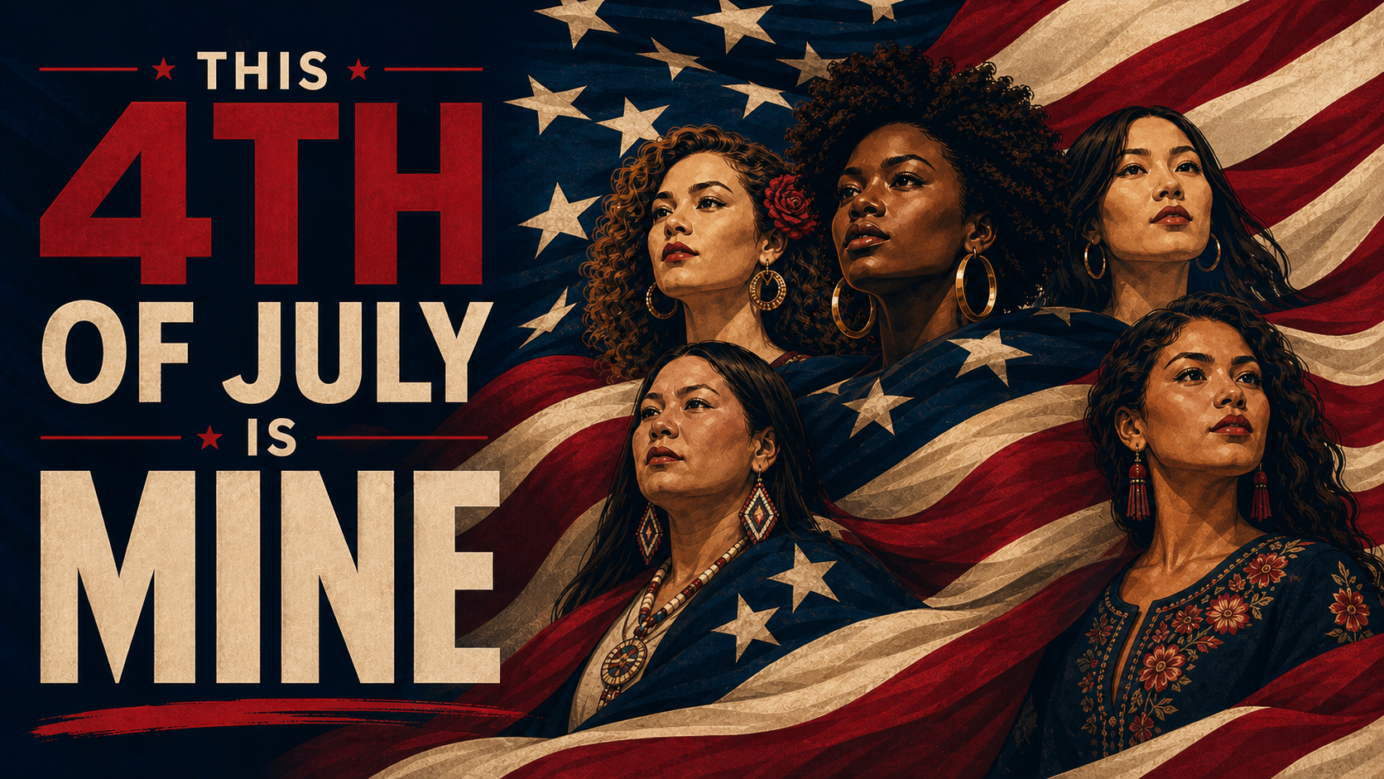
So, as I think about Douglass’ statement, “This Fourth of July is yours, not mine.” I do not believe this to be true. I believe my contributions to this country make the 250th Anniversary 4th of July, everyone in my lifetime, mine!
I believe Douglass was partially right.
America is false to the past, false to the present, and solemnly binds herself to be false to the future.
— Frederick Douglass (1852, p. 6)
I believe Douglass nailed it when he said,
At a time like this, scorching irony, not convincing argument, is needed. O! had I the ability, and could I reach the nation’s ear, I would, to day, pour out a fiery stream of biting ridicule, blasting reproach, withering sarcasm, and stern rebuke. For it is not light that is needed, but fire; it is not the gentle shower, but thunder. We need the storm, the whirlwind, and the earthquake. The feeling of the nation must be quickened; the conscience of the nation must be roused; the propriety of the nation must be startled; the hypocrisy of the nation must be exposed; and its crimes against God and man must be proclaimed and denounced.
— Frederick Douglass (1852, p. 7)
How each of us does the above is a personal choice. For six years, one of my choices has been WISER Wednesday — using disaggregated data, clear language, and intellectual acuity to shift narratives, make data more democratic, and influence how people think. WISER Wednesday is where, week after week, I insist that we see the people this country has tried not to count.
I invite you to join me not only in calling out the hypocrisy but also in doing the work to make the promises of the Declaration of Independence, the Constitution, and the Bill of Rights a reality for all Americans.
Rhonda V. Sharpe is the president and founder of the Women’s Institute for Science, Equity and Race. Her research focuses on gender and racial inequality, the diversity of STEM, and the demography of higher education.