

Last week I attended the 2026 Bridge Builders Summit hosted by the Economic Mobility Initiative and Share Our Strength. The summit’s theme was “Because of mom, a new world is emerging.” The convening opened with remarks by Michael McAfee, CEO of PolicyLink, who asked us to adopt a founder’s mindset.
As a founder, I understand that means creating something new — not perfect. Creating something that fills a void. Creating something that is innovative or a tweak to an old idea. I understand that being a founder means establishing a mission and vision, along with a set of ideals to achieve both. I also know that we can be flawed in the execution of those ideals to the mission and vision.
Because I understand the mindset of a founder, I am comfortable acknowledging the hypocrisy of American founding fathers and the flawed execution of the Constitution and Bill of Rights, and proud to be an American despite all the ways America has denied and hindered the rights in these documents and stolen from ancestors.
I can do this because to love these United States of America is to have hope in what this country can be despite the evidence (data) and to be optimistic because of the evidence (data). I am optimistic because of these women.
The Mary McLeod Bethunes who spent their earnings to create institutions for the marginalized.
The Dorothy Heights who purchase property for visibility and to show their strength.
The Ida B. Wellses who co-create newspapers to report the injustices and the triumphs.
The Kay Cole Jameses who create institutes to develop leaders.
The Heidi Hartmanns who create policy institutes focused on women.
The Janice Johnson Diases who create grassroots organizations that invest in girls.
The Cecilia Conrads and Leng Leng Chanceys who raise money to fund causes that increase the well-being of women and children.
The Chastity Lords who remind us to organize (single mothers) voters so their voices are heard.
The Lillian Singhs who remind us that feeding a child is important, but creating policies that affect a mother’s economic mobility is nonnegotiable.
The Julianne Malveauxes, Phyllis Wallaces, and Susan Collinses who use economics to advocate for the well-being of the marginalized.
The Nina Bankses who recover women’s contributions.
The Betty Sharpe Hopsons who rear capable, confident, and independent girls (women).
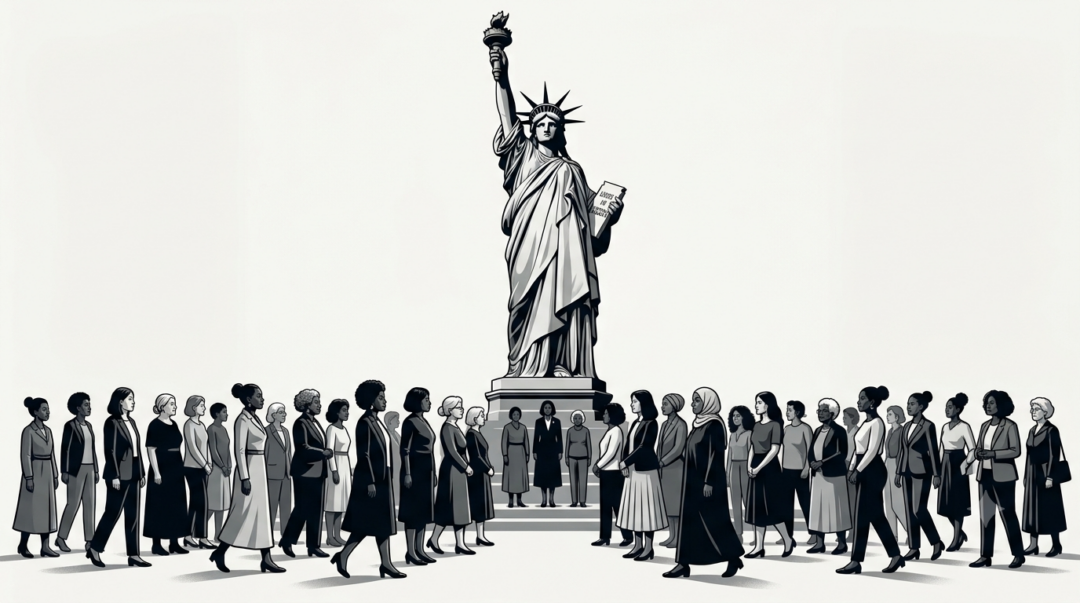
To the Statue of Liberty and all the statues in the United States that acknowledge freedom and those who fought to make the ideals of the Constitution and the Bill of Rights a reality.
Lady Liberty
On this date in 1885, the Isère arrived in New York Harbor carrying the Statue of Liberty in 350 pieces of copper and iron packed into 214 wooden crates. Technically, the Statue of Liberty is the original 350-piece puzzle. Two days later, on June 19, the crates reached Bedloe’s Island. The irony is that June 19 would be celebrated as Juneteenth, the day in 1865 when enslaved people in Texas finally heard that they were free. A monument created to celebrate emancipation arrived in pieces to its resting site on the anniversary of emancipation’s delay. That is both poetry and irony.
We know that many of the amendments and laws that extend and protect the rights espoused in the Constitution and the Bill of Rights came because of compromises. French abolitionist Édouard de Laboulaye conceived the monument, and Bartholdi translated that intention into a design with broken chains in Lady Liberty’s left hand. In the years between conception and delivery, Reconstruction had been abandoned, and the federal government had stopped protecting the rights of formerly enslaved people. The compromise (unclear who negotiated) moved the chains to her feet — invisible to visitors standing below.
The 13th, 14th, and 15th Amendments had been written. The promises were on paper. The chains were on the ground. And the nation looked away. At her dedication in 1886, African American newspapers called out the hypocrisy. On June 17, 2021, President Biden signed the Juneteenth National Independence Day Act into law, the same date the Isère entered the New York Harbor 136 years earlier. It is the first new federal holiday since Martin Luther King Jr. Day in 1983. Juneteenth is a holiday that marks the delayed freedom of the enslaved in Texas.
The right to gather
The First Amendment guarantees the right to assemble. It does not guarantee that the assembly will be safe. On June 17, 2015, 199 years after Emanuel AME Church was founded in Charleston in 1816 (College of Charleston) by free and enslaved Black Charlestonians who wanted a place to worship on their own terms, a gunman walked into a Bible study and murdered nine people. They are the Emanuel Nine: Rev. Clementa C. Pinckney, Cynthia Graham Hurd, Susie Jackson, Ethel Lance, DePayne Middleton-Doctor, Tywanza Sanders, Rev. Daniel Simmons Sr., Rev. Sharonda Coleman-Singleton, and Myra Thompson. The congregation opened its doors four days later. That is not a metaphor. It is hope.
At the summit, Rev. Shavon Arline-Bradley, President and CEO of the National Council of Negro Women, asked us to be radical, which does not mean violent, but not being who you are today. The room was full of people doing what the Constitution promises: assembling, speaking, demanding better — for single mothers. Alencia Johnson, the emcee, reminded us of these words:
“Well-behaved women seldom make history.” — Laurel Thatcher Ulrich
So today, I honor the women who were not “well-behaved.” Patsy Takemoto Mink was a Japanese American woman from Hawaii who, in 1964, became the first Asian American woman elected to Congress. All 72 Congresswomen before her were white. She co-authored Title IX. Deb Haaland of the Laguna Pueblo and Sharice Davids of the Ho-Chunk Nation became the first Native American women elected to Congress in 2018, 230 years after Congress first convened. In New Mexico, women now hold 55 percent of legislative seats, the largest female majority of any state legislature in the country, with Hispanic and Indigenous women among its leaders.
When organizers of the 1913 suffrage parade told Black women to march at the back, Ida B. Wells walked to the front of the Illinois delegation and stayed there. The Constitution does not promise comfort. It promises the right to gather and demand more.
The women this organization centers — Asian, Black, Hispanic, Indigenous American, and Multiracial women — have been making history while being written out of it. Patsy Mink wrote Title IX and spent years watching institutions ignore it. Deb Haaland convened the first House hearing on murdered and missing Indigenous women. Ida B. Wells ran an anti-lynching newspaper out of Memphis until the press was burned to the ground, then moved to Chicago and kept writing. None of these women, nor I, asked for permission.
I was not reared to be a well-behaved girl. I was reared to be a confident, independent, and capable girl. What I love about these United States is that, because of women who fought so that the Constitution would cover me, I can live out my founder’s mindset in the work of the Women’s Institute for Science, Equity and Race.
Rhonda V. Sharpe is the president and founder of the Women’s Institute for Science, Equity and Race. Her research focuses on gender and racial inequality, the diversity of STEM, and the demography of higher education.